
Growth Characteristics and Traditional Uses of Colocasia esculenta
Advertisement
Colocasia esculenta, commonly known as taro, is a perennial herbaceous plant belonging to the Araceae family. With a cultivation history spanning thousands of years, it is not only a staple food crop in tropical and subtropical regions but also a plant with significant ecological adaptability and rich traditional utilization value. From its unique morphological structure and growth habits to its diverse applications in food, medicine, and culture, Colocasia esculenta has woven a close connection with human society.
I. Growth Characteristics of Colocasia esculenta
Colocasia esculenta has evolved a set of growth characteristics adapted to warm and humid environments through long-term natural selection, with distinctive morphological features and environmental adaptability that lay the foundation for its wide cultivation.
1.1 Morphological Characteristics
The most striking feature of Colocasia esculenta is its large, ornamental foliage, which earns it the common name "elephant ears". It is a clump-forming perennial with a well-developed underground storage structure—globose or cylindrical corms that serve as the main organ for starch accumulation. The corms are thick and fleshy, rich in digestible starch, and can grow up to 15 centimeters in diameter when mature, with small lateral tubers (cormels) growing around the base, which are often used for propagation .
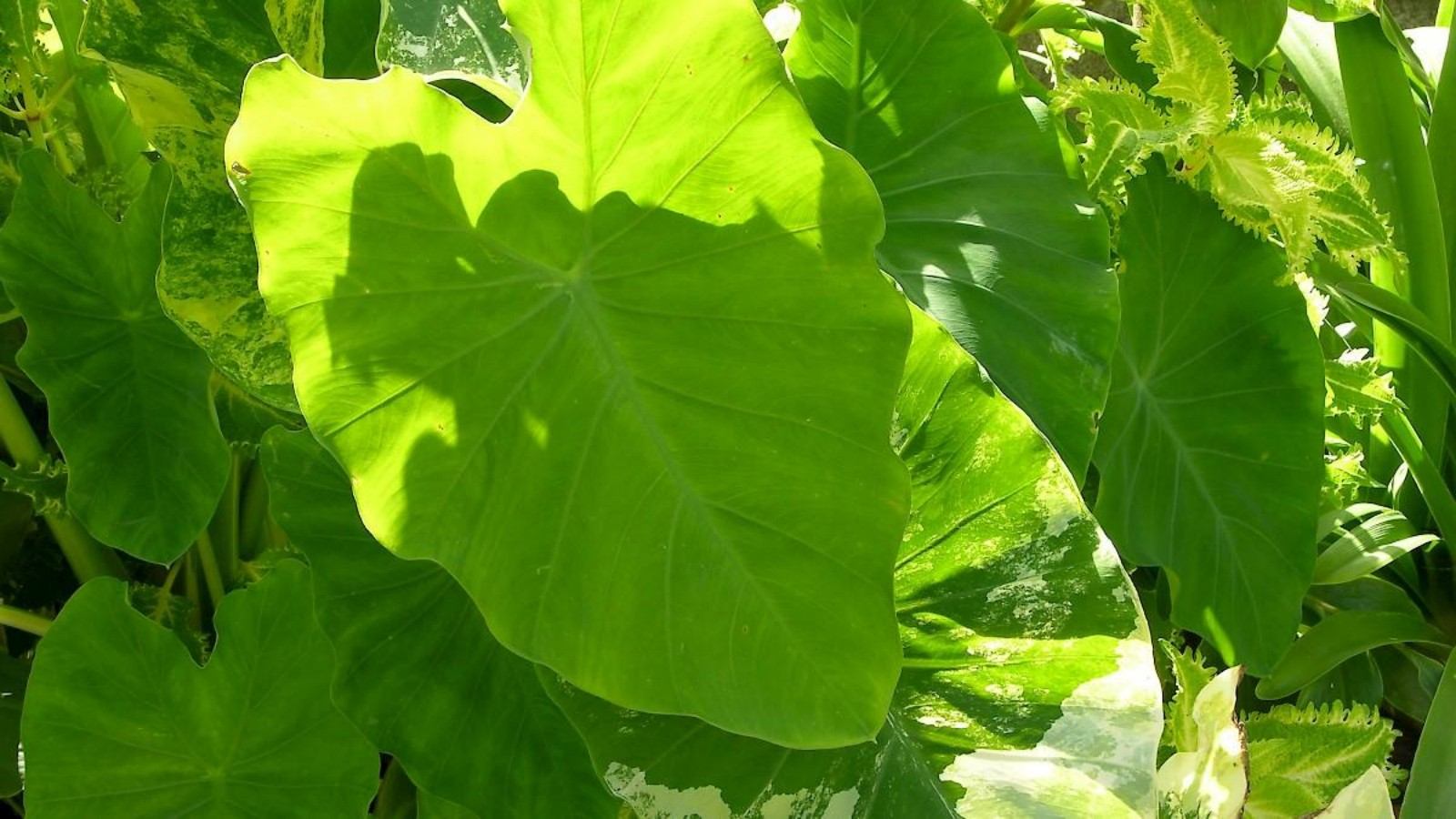
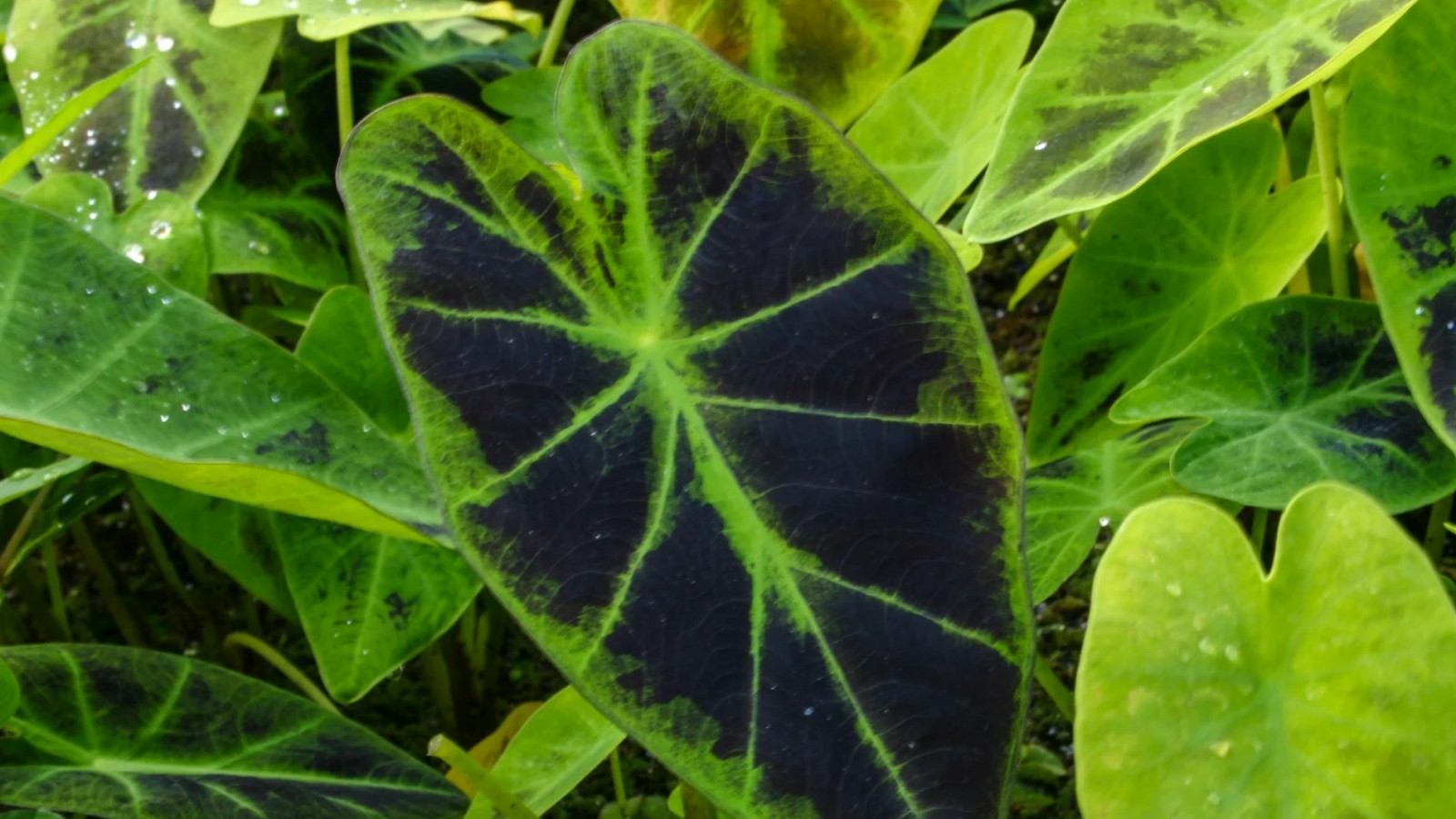
The leaves of Colocasia esculenta grow on erect, thick petioles that can reach 1-2 meters in length, with colors ranging from green to red, black, or variegated, adding to its ornamental value. The leaf blades are heart-shaped or arrow-shaped (sagittate), with a soft velvety texture on the surface, measuring 40-60 centimeters in length and 25-30 centimeters in width. Unlike its relative Alocasia, the leaves of Colocasia esculenta face outward and downward, which helps to capture scattered light in shaded environments . The leaf veins are prominent, forming a dense network that supports the large leaf area and facilitates nutrient transport.
The inflorescence of Colocasia esculenta is a typical spadix enclosed by a spathe, a characteristic feature of the Araceae family. The spathe is yellowish-white and tubular, while the spadix bears unisexual flowers—female flowers at the base, male flowers in the upper part, and sterile flowers in between. However, in cultivation, flowering is relatively rare, as the plant tends to allocate more energy to corm development rather than reproduction .
1.2 Environmental Adaptability
Colocasia esculenta is a crop native to tropical and subtropical regions, with a strong preference for warm and humid climates. It thrives in temperatures between 20-30℃, with a minimum temperature requirement of 15℃ for normal growth. It is not frost-tolerant; temperatures below 5℃ will cause leaf yellowing and wilting, while frost will directly damage the corms. In regions with cold winters (USDA hardiness zones below 9), it is usually cultivated as an annual or the corms are dug up for winter storage .
In terms of soil requirements, Colocasia esculenta prefers loose, fertile, well-drained sandy loam or alluvial soil rich in organic matter, with an optimal pH range of 5.5-6.5 (slightly acidic to neutral). It has strong adaptability to soil moisture—there are both dry-cultivated varieties and wetland varieties that can grow in flooded paddy fields. However, prolonged waterlogging or drought will affect its growth: sufficient moisture promotes corm expansion, while drought may lead to stunted growth and reduced yield . Under rainfed conditions, it requires evenly distributed annual rainfall of 120-150 cm during the growth period; supplementary irrigation is necessary in case of prolonged drought .
1.3 Growth Cycle and Propagation
The growth cycle of Colocasia esculenta varies depending on the cultivation method and climate, generally ranging from 8 to 16 months. For rainfed crops, sowing is usually done in May-June, with harvest in October-November; irrigated crops can be planted year-round in suitable climates . The plant goes through four stages: germination, seedling growth, corm expansion, and maturity. During the corm expansion stage (60-90 days after planting), the plant accumulates a large amount of starch, which is the key period for yield formation.
Propagation of Colocasia esculenta mainly relies on asexual methods, with lateral tubers (25-35 grams each) being the most commonly used propagation material. Approximately 37,000 tubers weighing about 1,200 kilograms are required per hectare of cultivation. The tubers are planted on ridges at a spacing of 45 centimeters, and mulching is applied after planting to retain moisture and promote germination . Sexual propagation by seeds is rarely used in production due to low germination rates and unstable offspring traits; division of clumps is another alternative propagation method, usually carried out in winter during dormancy .
1.4 Nutrient and Water Requirements
Colocasia esculenta has high nutrient requirements, especially for nitrogen, phosphorus, and potassium. Before planting, 12 tons of compost per hectare is recommended as basal fertilizer to improve soil fertility. After sprouting, a total of 80 kg of nitrogen, 25 kg of phosphorus, and 100 kg of potassium per hectare should be applied in two installments: half of the nitrogen and potassium, plus all the phosphorus, are applied within one week after sprouting, and the remaining nitrogen and potassium are applied one month later along with weeding and earthing up . This fertilization regime ensures vigorous foliage growth in the early stage and sufficient nutrient supply for corm expansion in the later stage.
Water management follows the principle of "appropriate moisture during growth and dryness before harvest". Irrigation is carried out immediately after planting and one week later to ensure uniform sprouting; subsequent irrigation is done every 12-15 days depending on soil type. To promote starch accumulation, irrigation should be stopped 3-4 weeks before harvest. For rainfed crops, supplementary irrigation is essential during prolonged drought to prevent yield loss .
II. Traditional Uses of Colocasia esculenta
For thousands of years, Colocasia esculenta has been deeply integrated into the life and culture of people in tropical and subtropical regions. Its corms, leaves, and petioles are all valuable resources, with traditional uses covering food, medicine, and even cultural rituals, reflecting the wisdom of local people in utilizing natural resources.
2.1 Food Uses: A Staple Crop with Diverse Preparation Methods
As a staple food crop, Colocasia esculenta is valued for its high starch content and nutritional value. Its corms are rich in carbohydrates, minerals (potassium, calcium, iron), and vitamins A, B, and C, with starch digestibility as high as 98.8%, making it an ideal food for infants, the elderly, and those with digestive sensitivity . Notably, all parts of the plant contain calcium oxalate crystals, which have an acrid taste and can cause oral irritation; therefore, thorough cooking (boiling, baking, or steaming) is necessary to destroy these crystals before consumption .
In different regions, Colocasia esculenta has developed unique food cultures. In Hawaii, the corms are mashed into a paste called "poi", which is a traditional staple food and plays an important role in local rituals . In the Caribbean, young leaves are cooked into a dish called "callaloo", often paired with coconut cream or seafood . In Southeast Asia, the corms are used to make taro chips, taro flour, and desserts such as taro paste buns, while the petioles are stir-fried with garlic or pickled as a side dish. In China's southern regions, taro is often boiled with glutinous rice to make festive foods, symbolizing "abundance and prosperity" .
Beyond direct consumption, the corms are also processed into dehydrated products, starch, and even used as a substitute for wheat flour in gluten-free food production. Its high starch content and unique physicochemical properties make it suitable for making biodegradable plastics, laying the foundation for its modern industrial applications .
2.2 Medicinal Uses: Ethnomedicinal Wisdom Passed Down for Generations
Colocasia esculenta has a long history of medicinal use in traditional medicine systems of various regions, with almost all parts of the plant being used to treat a variety of ailments. Modern phytochemical studies have confirmed that it contains bioactive compounds such as phenolics, flavonoids, and alkaloids, which are the material basis for its medicinal effects .
In Hawaiian traditional medicine, poi is used to soothe the stomach and treat diarrhea when mixed with arrowroot starch. Mashed taro leaves combined with Hawaiian salt are applied as a poultice to treat wounds and infections, while the juice of raw taro mixed with sugar is taken orally to reduce fever . The petiole juice has hemostatic properties and can be used to stop surface bleeding, and rubbing the cut petiole on insect stings can relieve swelling and pain .
In the Philippines, the Pinatubo Negritos use taro to treat earaches and rheumatism—heated tubers are applied to painful joints to alleviate discomfort . In Malaysia, warmed taro leaves are used as a compress to adjust the head shape of infants with elongated skulls . In Indian traditional medicine, taro corms are used as a laxative for hemorrhoids, and honey mixed with tuber ash is applied to treat oral ulcers . These traditional remedies reflect the diverse pharmacological potential of Colocasia esculenta, which has been validated by modern studies for its antioxidant, anti-inflammatory, and antimicrobial activities .
2.3 Other Traditional Uses: Cultural and Ecological Value
Beyond food and medicine, Colocasia esculenta also has applications in culture, animal husbandry, and landscaping. In many tropical regions, it is regarded as a sacred plant—Hawaiians believe that taro is the ancestor of humans and plays a core role in religious rituals and cultural ceremonies . In some Southeast Asian communities, taro is planted around houses to ward off evil spirits, embodying people's reverence for nature.
In animal husbandry, the peel of taro corms and leftover foliage are used as feed for livestock, as they are rich in fiber and nutrients . In landscaping, its large, exotic leaves make it a popular ornamental plant for patios, pondsides, and tropical gardens. Wetland varieties are particularly suitable for planting in bogs and pond edges, while potted varieties can be grown indoors as architectural plants, adding a tropical vibe to the space .
Colocasia esculenta is a versatile plant that integrates food, medicine, and ornamentation, with unique growth characteristics and profound traditional value. Its strong environmental adaptability enables it to thrive in diverse climates, while its rich nutritional and medicinal components have made it a vital part of human life for thousands of years. From the staple poi in Hawaii to the medicinal poultices in Southeast Asia, from the ornamental foliage in gardens to the feed in farms, Colocasia esculenta has demonstrated extraordinary value across cultures and regions.
In modern society, with the deepening of research on its phytochemical properties and industrial applications, Colocasia esculenta is no longer just an ancient traditional crop but also a promising resource for functional foods, pharmaceuticals, and biodegradable materials. Preserving and inheriting the traditional uses of Colocasia esculenta while exploring its modern value will help fully tap the potential of this crop and contribute to sustainable agriculture and human health.
Advertisement
Learn More
-

- October 20,2026
- Lily Disease Guide: Whats Killing Your Lilium longiflorum and How to Stop It
-
- September 17,2026
- Wax-Leaf Privet Diseases: Identification, Treatment & Prevention Guide
-
- September 1,2026
- Vinca Minor Diseases: Identification, Treatment and Long‑Term Garden Management
-
- August 18,2026
- Tree Philodendron Diseases: Identification, Treatment and Long‑Term Prevention
-
- August 6,2026
- Common Ailments of Plantago major: Identifying, Treating and Preventing Diseases in Broadleaf Plantain
-
- July 30,2026
- Zodiac-themed Bouquets Combined with Floral Language: Different Color Schemes Create More Artistic Birthday Surprises


Advertisement

 Poisonous and danger
 Edible and medicinal
 Wild and common weed